
How to Use a Torque Wrench
A practical guide to setting, using and caring for Torque Master click-type torque wrenches: standard (TM), ratchet type (TM R) and interchangeable head (TM i) models.
Health & safety
Warning: misuse of this tool can cause serious injury. Make sure you have read and understood all of these safety instructions before use.
- Do not use the torque wrench as a breaker bar or to loosen fasteners. This will damage the torque wrench and invalidate the warranty.
- Always refer to the manufacturer's literature, workshop manual or authorised data for the recommended torque settings and, where applicable, the correct tightening sequence for the fasteners.
- Never exceed the maximum capacity of the torque wrench. Overloading can cause permanent damage and affect calibration accuracy.
- Do not use extensions or adapters that significantly alter the effective length of the wrench unless the proper torque calculations are made.
- Wear suitable personal protective equipment (PPE), including safety glasses and appropriate hand protection.
- Keep the work area clean and well lit. Cluttered or dark work areas can lead to accidents.
- Store the torque wrench at its lowest setting to maintain calibration accuracy and extend the life of the tool.
Unpacking: what's in the box
Carefully remove the torque wrench from its protective case and inspect it for any signs of damage that may have occurred during shipping. Check that the following items are included:
- Torque wrench, with its unique serial number
- Protective carrying case (blow-moulded or steel, depending on the model)
- Calibration certificate
- Instruction manual
- Tommy bar (models TM 400/400R and above)
If any parts are missing or damaged, contact your supplier immediately. Please dispose of all packaging materials responsibly, in line with local regulations.
Before first use
If the torque wrench is new, or has been in storage for some time, operate it several times at a low torque setting. This allows the internal lubrication to re-coat the working parts.
At low torque settings the signal is soft, so try the wrench on a non-critical fastener first to become familiar with the feel of the break-away.
Setting the torque value
TM 10/10R to TM 300/300R: setting knob
- Select the required torque scale (N·m, lbf·ft, kgf·m or lbf·in) marked on the torque wrench body.
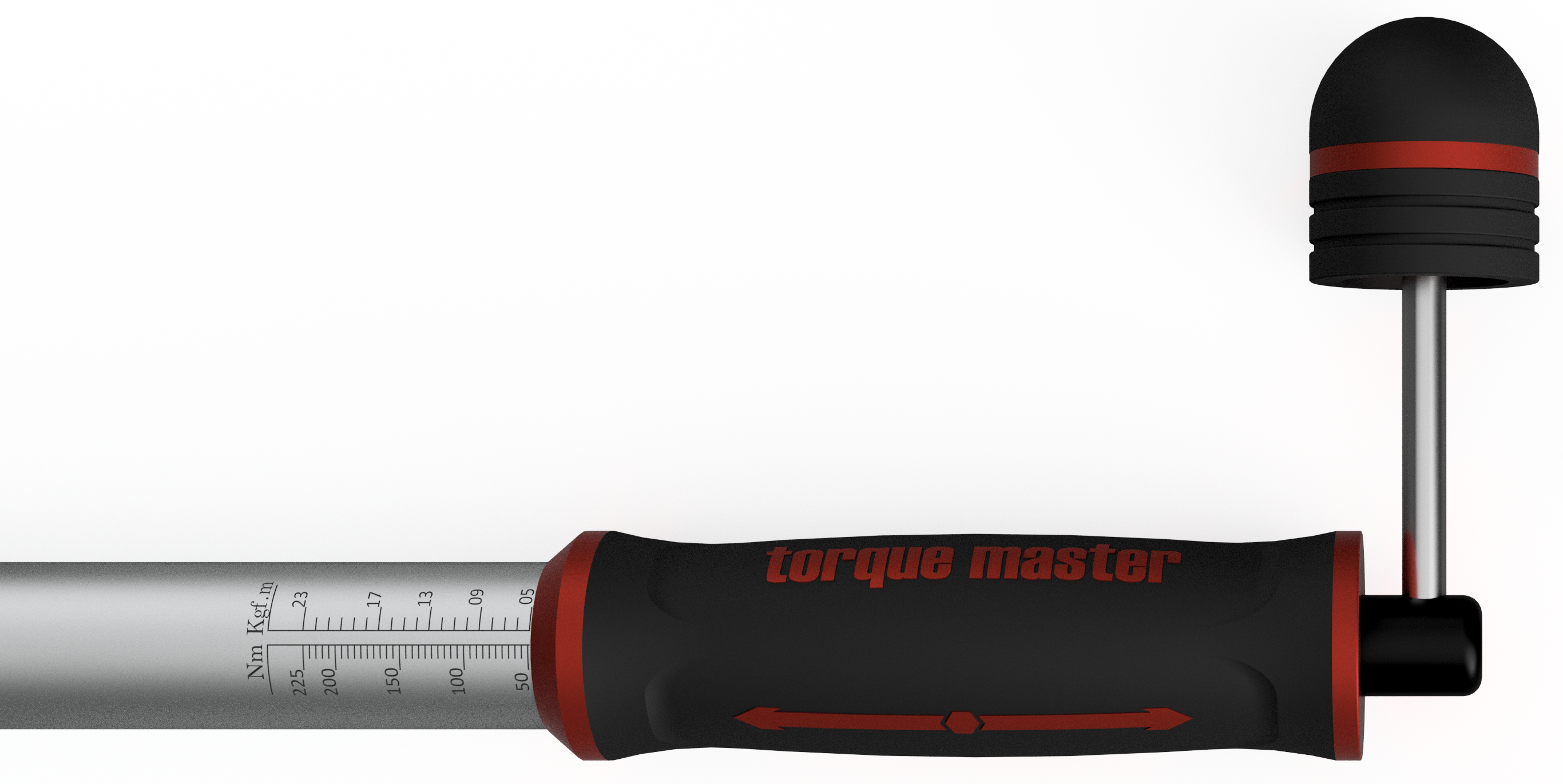
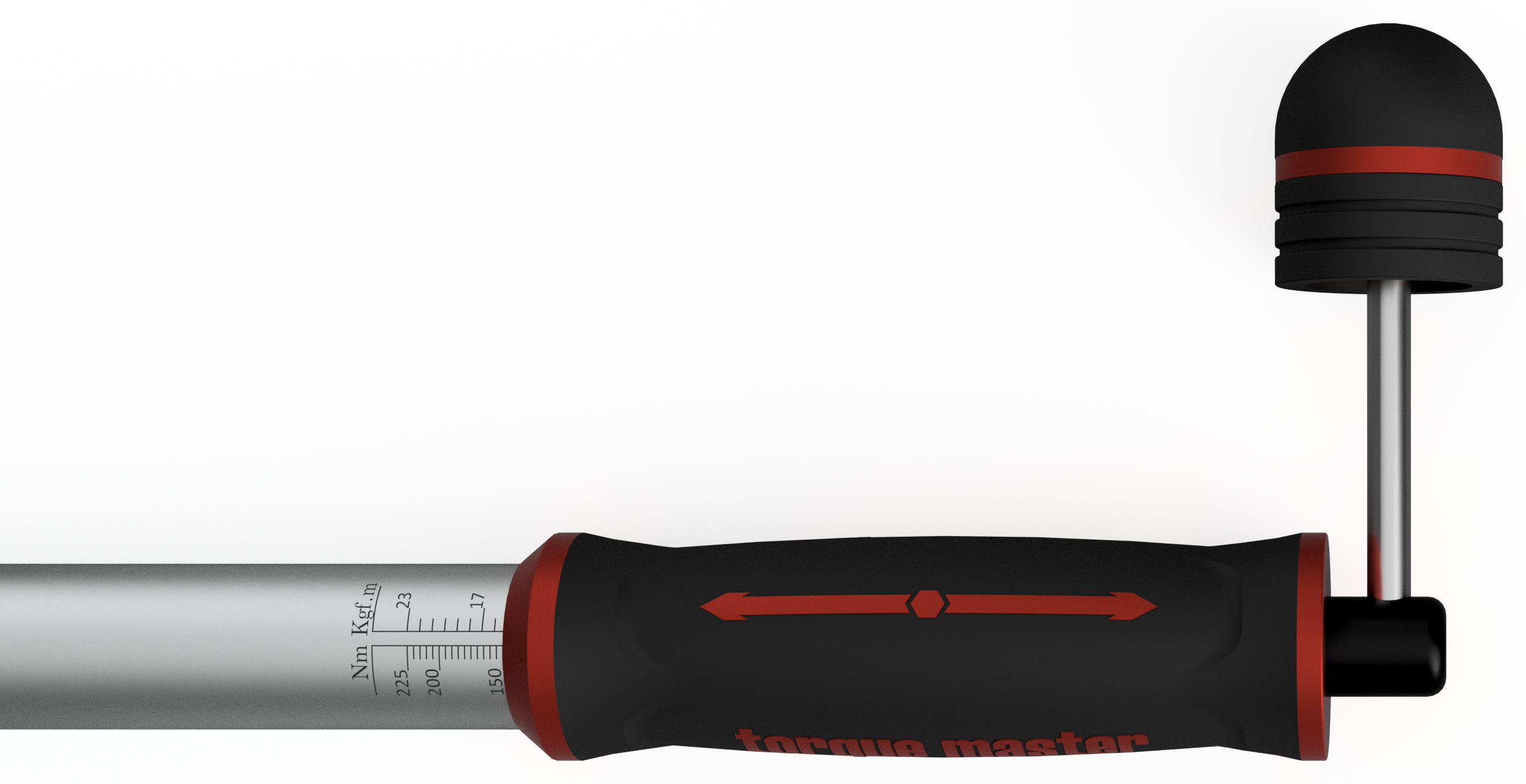
- Pull out the torque-setting knob at the end of the grip and lock it into the spindle at 90 degrees.
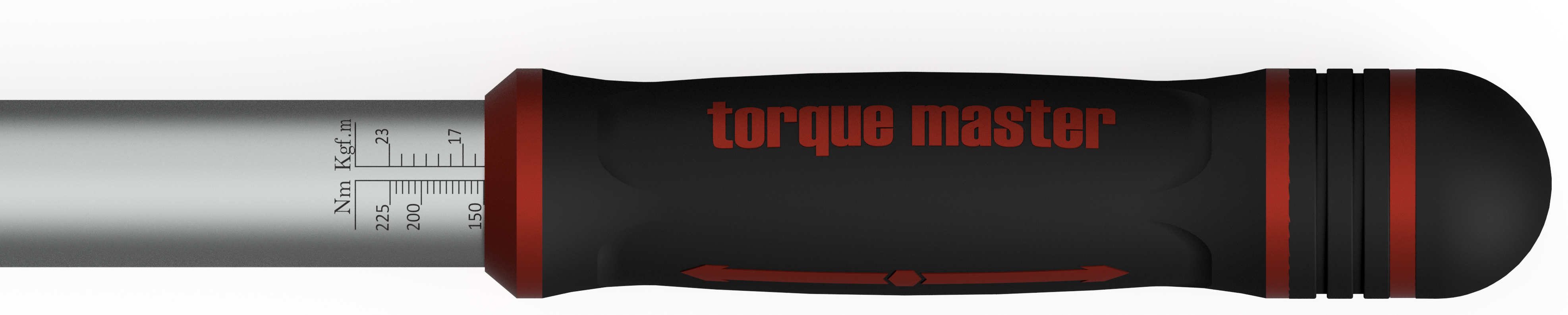
- Turn the knob until the edge of the handle aligns with the required torque value on the scale.
- When the value is correctly set, align the knob and push it back into the handle body to lock the setting.

TM 400/400R and above: tommy bar
- Select the required torque scale (N·m, lbf·ft, kgf·m or lbf·in) marked on the torque wrench body.
- Insert the tommy bar supplied with the torque wrench into the hole in the screw just below the steel handle grip.
- Turn the tommy bar until the edge of the handle aligns with the required torque value on the scale.
Important: to obtain the correct torque setting, only move the handle upwards through the range. Do not set the required torque by moving down through the range, as this will not give the correct setting.
Need to set a value given in another unit? Use the torque unit converter to convert between N·m, lbf·ft, kgf·m, lbf·in and kgf·cm.
Applying torque
- Check the direction arrow on the torque wrench head to make sure it is correct for the thread direction (right-hand or left-hand).
- On models with a push-through drive square, push the drive square through the head from the side that makes the direction arrow correct for your application.
- Attach the appropriate socket or accessory to the drive square.
- Apply force smoothly and steadily in the direction indicated by the arrow. Do not apply force with jerking motions.
Important: only pull in the direction of the arrow. Applying force incorrectly will permanently damage the torque wrench mechanism.
The signal: sight, touch and sound
When the set torque is reached, the three-phase mechanism gives all three indications:
- Sound: a distinct click. The click is quieter at lower torque settings.
- Touch: the handle is felt to break away at the set torque.
- Sight: the handle is seen to break away at the set torque.
Stop pulling as soon as the set torque is reached. Continuing to pull after the signal will apply an incorrect torque and may damage parts. At low torque settings the break-away is very soft, so practise on a non-critical fastener first.
After use & care
- After use, always reset the torque wrench to its lowest setting. Storing it at any other setting will affect its calibration.
- Do not turn the adjustment below the lowest torque setting.
- Clean the wrench by wiping it with a soft, dry cloth. Do not immerse it in any type of cleaner, as this will affect the internal lubrication.
- Return the torque wrench to its case for protection from damage and contamination.
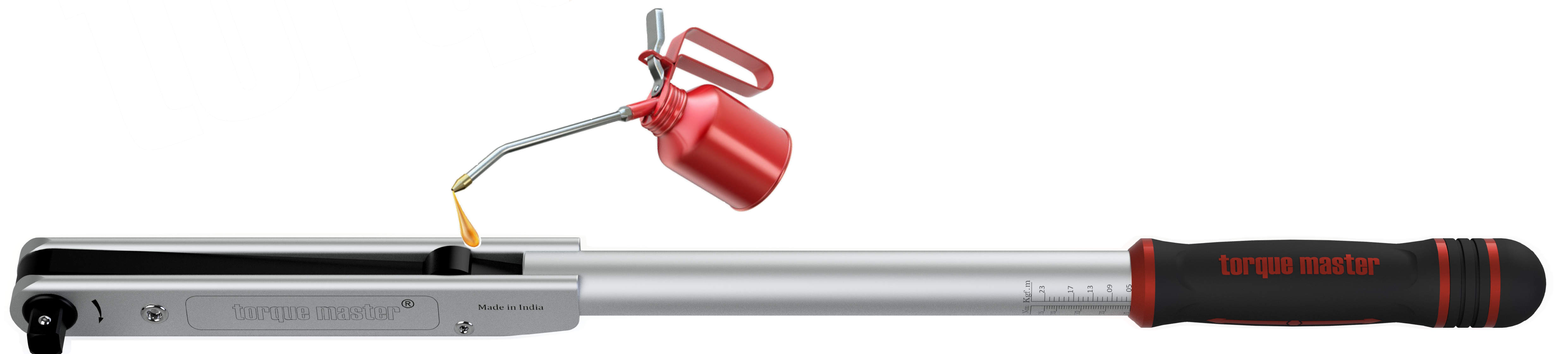
- Periodically lubricate the moving parts with lubricating oil, as shown below.
- Never use the torque wrench to undo nuts, bolts or other fasteners; this will damage the mechanism.
- The tool is rugged and designed for general use, but it is also a precision measuring instrument and should be treated as one.
- Do not attempt to adjust or repair the torque wrench yourself. A full repair and calibration service is available on request, at a charge.
Interchangeable head models (TM i series)
TM 10i to TM 250i interchangeable head torque wrenches have a 16 mm spigot that accepts:
- Ratchet heads with 3/8", 1/2" and 3/4" square drive
- Open-end fittings from 8 mm to 32 mm A/F
To attach a head: align the head with the spigot and push firmly until it clicks into place. To remove a head: press the release button and pull the head away from the body.
Always make sure the head is securely locked before applying torque. An improperly attached head can cause inaccurate torque readings and potential injury.
See the TM i series specifications for ranges and the full list of fittings.
Handling & storage
- Make sure you have a good, stable position while using the torque wrench. Take care because of the rotating parts and the forces applied.
- Store the torque wrench, together with its instruction manual, in its protective case in a cool, dry place, with the wrench set to its minimum setting.
- Clean, maintain and lubricate the torque wrench regularly to keep it performing at its best.
Calibration & recalibration
The recalibration interval is set by the user, based on the required accuracy, frequency of use, typical load, and the operating and storage conditions. If you do not have a control procedure, use a default interval of 12 months or approximately 5,000 cycles, counted from the date of first use. Recalibrate immediately after an overload greater than 125% of the maximum rated load, after any repair, and after any mishandling, such as a drop.
Calibration, recalibration and warranty details · Torque wrench FAQ